

Most distributors start by using their supplier's part number as their own. It works, right up to the point where a second supplier appears with an overlapping catalogue, or the first supplier renumbers their range, or you want to dual-source a part. Then it stops working, and by then there are thousands of records depending on it.
Why supplier numbers fail as your identity
They are not yours to control. A supplier can renumber, discontinue or re-scope a number and you find out from a purchase order that bounces.
They collide. Two suppliers use the same number for different parts. Not a hypothetical — short numeric part numbers are used across the industry and overlaps are routine.
They cannot express dual sourcing. If the same o-ring comes from two factories, whose number is it? Using either is misleading; using both means the same physical item has two identities in your system.
They mix identity with sourcing. A part number should say what a thing is. Where you buy it is a separate fact that changes over time.
What a good scheme looks like
Boring, short, and meaningless.
PP-SEA-0142
│   │    └─ sequence, assigned in order, never reused
│   └────── category code
└────────── your prefix
Three properties that matter:
1. Never confusable with an OEM number. This is the one people get wrong. A scheme that mimics OEM formats produces support calls forever — a customer reads your number, assumes it is an OEM number, and searches for it. Your prefix should make that impossible.
2. Non-significant sequence. Do not encode size, material or supplier into the digits. Every attribute you encode is an attribute that will change, and then your number is lying. Attributes belong in fields, not in the identifier.
3. Never reused. When a part is discontinued its number retires with it. Reused numbers surface years later as mis-picks, and the cost of tracing one exceeds any benefit from a tidy sequence.
The category code is optional. It helps humans scan a picking list and costs nothing, provided you accept that a part occasionally sits in a category that no longer fits and you do not renumber it for that reason.
The three-layer model
Keep these separate. Collapsing any two is the root of most parts-data problems.
| Layer | What it is | Example |
|---|---|---|
| Your SKU | Your identity for a physical item | PP-SEA-0142 |
| OEM cross-references | Numbers this replaces | Many per SKU |
| Supplier part numbers | What each supplier calls it | One per supplier |
The relationships: one SKU has many cross-references; one SKU has one supplier number per supplier. Dual sourcing becomes trivial in this model — a second row in the supplier table — and impossible in a flat one.
A fourth thing to keep separate: equipment models
Cross-references and fitments are different data and mixing them causes ordering errors.
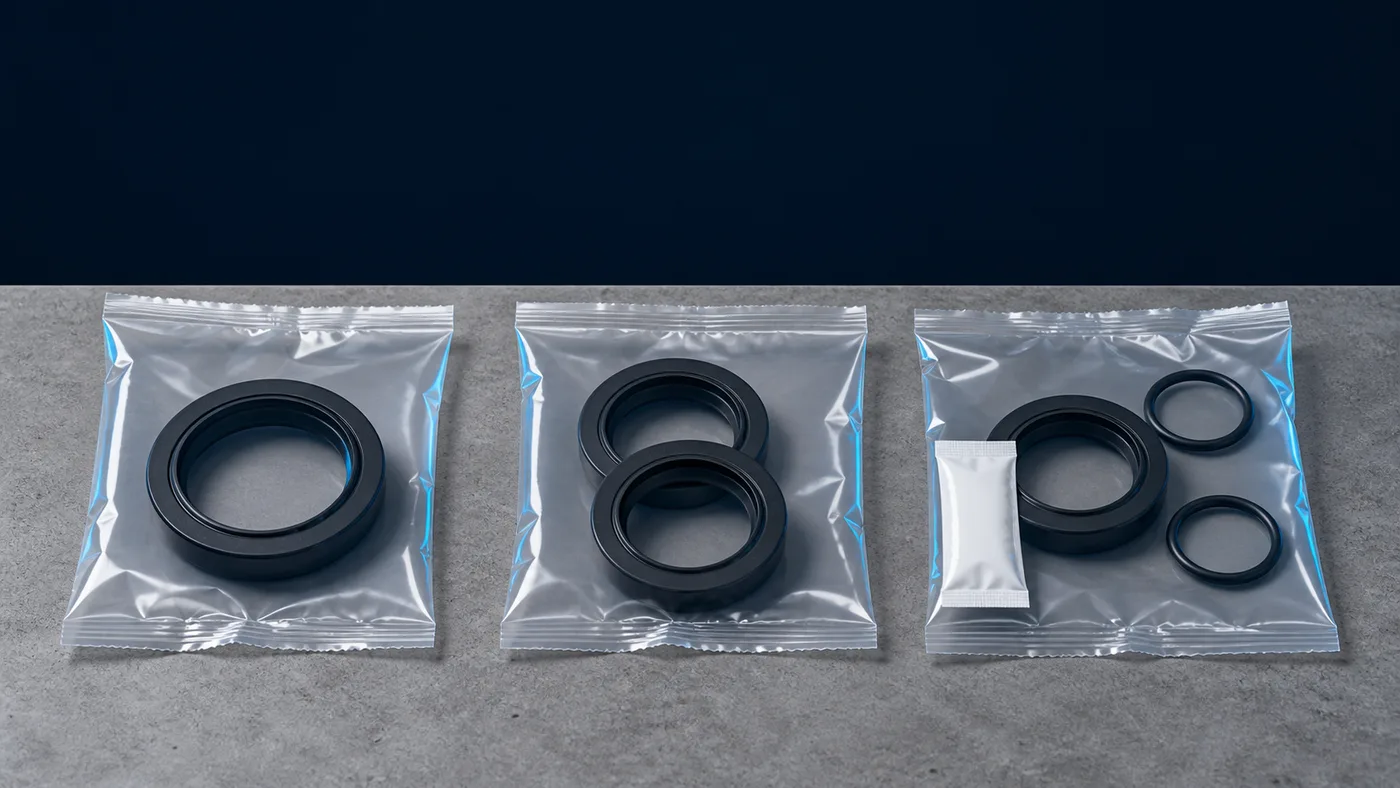
A cross-reference is another name for this part. A fitment is a machine this part goes into. R0358400 cross-references to other seal numbers; it fits equipment models CV340, CV460 and CV580. Those are different relationships, and a customer who orders against an equipment model expecting a component receives something they did not want.
Keep them in separate tables and label them differently in your catalogue. A single field called "compatible with" that contains both is a returns generator.
Migrating from supplier numbers without stopping trading
The fear that keeps people on supplier numbers is that changing is disruptive. It does not have to be.
Step 1. Add a new field for your SKU. Do not remove anything. Step 2. Assign your numbers to the existing catalogue. Mechanical work, an afternoon for a few hundred parts. Step 3. Move the old supplier number into a supplier-reference field. It stays searchable, so nothing breaks for anyone who knows it. Step 4. Switch your internal documents — purchase orders, picking lists, invoices — to your SKU. Print the supplier number alongside during a transition period. Step 5. Update customer-facing listings last, keeping the old number as a searchable alias permanently.
At no point does anything become unfindable. The old numbers keep working as search terms forever, which is the whole trick.
The cross-reference table is your real asset
Whatever numbering you choose, the mapping from OEM numbers to your SKUs is the thing that appreciates. It is what lets a customer arrive with a number stamped on a broken part and leave with the right item, and it survives any individual supplier relationship.
Two rules for maintaining it:
Record the source of every entry. Where the number came from and what confirmed it. Without that, you cannot audit later and you will not know which entries to distrust when one turns out wrong.
Require more than one source. A single marketplace listing that mentions two numbers together is not confirmation — sellers put numbers in titles for keyword reasons, not specification reasons. Entries built that way carry a materially higher error rate than entries confirmed independently twice.
What to do this week if you have no system
- Pick a prefix. Two or three letters, unmistakably yours.
- Add a SKU field to whatever system you use, even a spreadsheet.
- Assign numbers to your top 100 parts by volume.
- Add a supplier-reference field and move the existing numbers into it.
- Start recording the source for every cross-reference from today.
That is a day's work now and a project you cannot afford later.
Sourcing
POOLPOINT publishes its own part numbers alongside the OEM numbers each part replaces, and keeps equipment fitment data separate from cross-reference data for exactly the reason described above. If you are building your own catalogue, we will supply the cross-reference and fitment data for the parts you buy in a form you can import.