
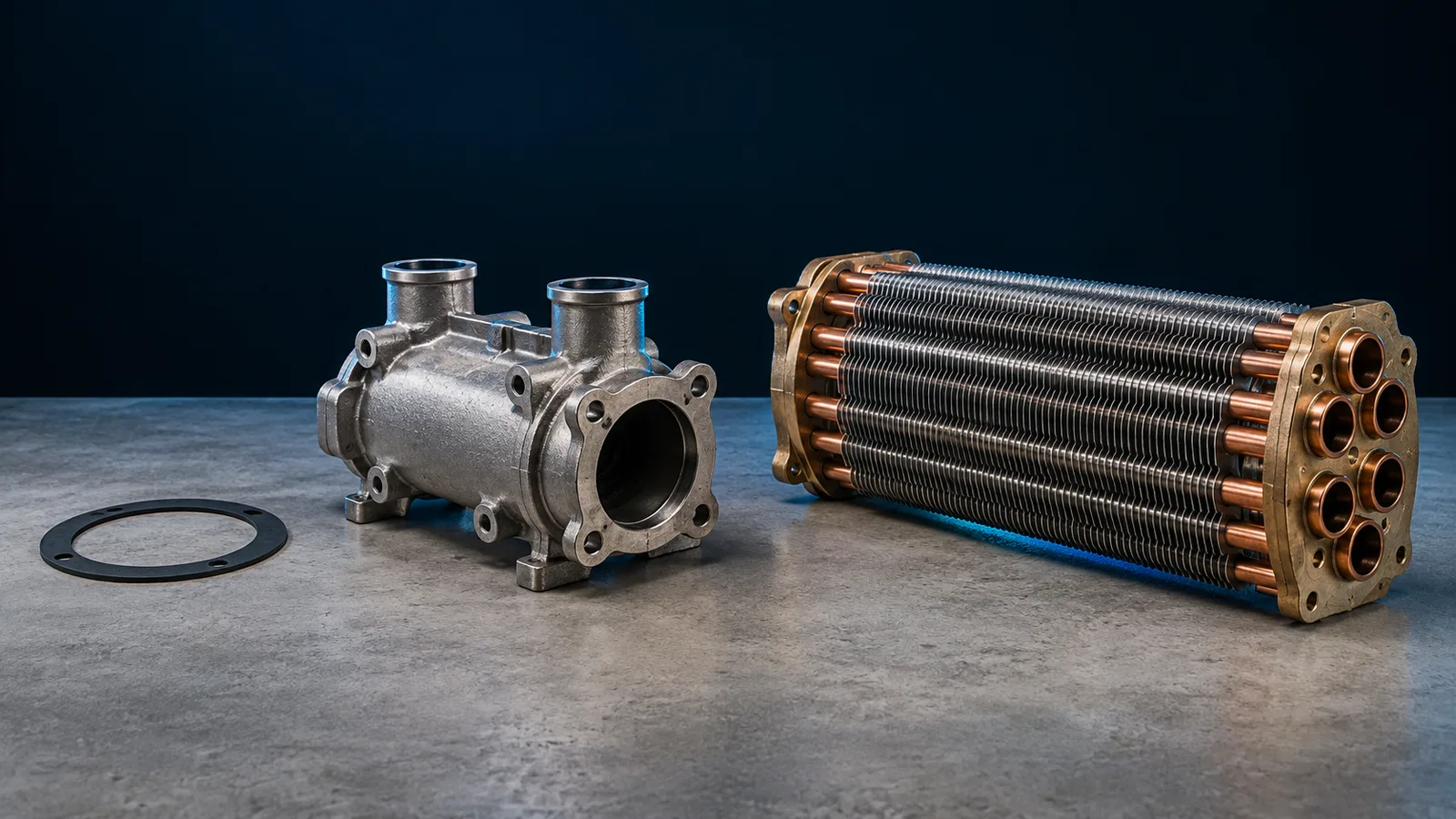
Water on the pad under a heater is the start of a conversation, not the end of one. The same puddle can mean a flat gasket that costs less than the trip charge, a cracked cast-iron header, or a tube bundle that has been quietly dying for three seasons. Those three repairs sit an order of magnitude apart, and the wrong call in either direction is expensive: quoting a bundle for what was a gasket loses the job, and fitting a gasket to a heater whose exchanger is finished means going back.
This guide is the decision layer above our model-specific service articles. It covers the four families that make up most of the installed base — Raypak digital and millivolt, Pentair MasterTemp and Max-E-Therm, Pentair MiniMax, and Teledyne Laars — and works through the diagnosis in the order that costs the least to be wrong about.
Find where the water is actually coming from
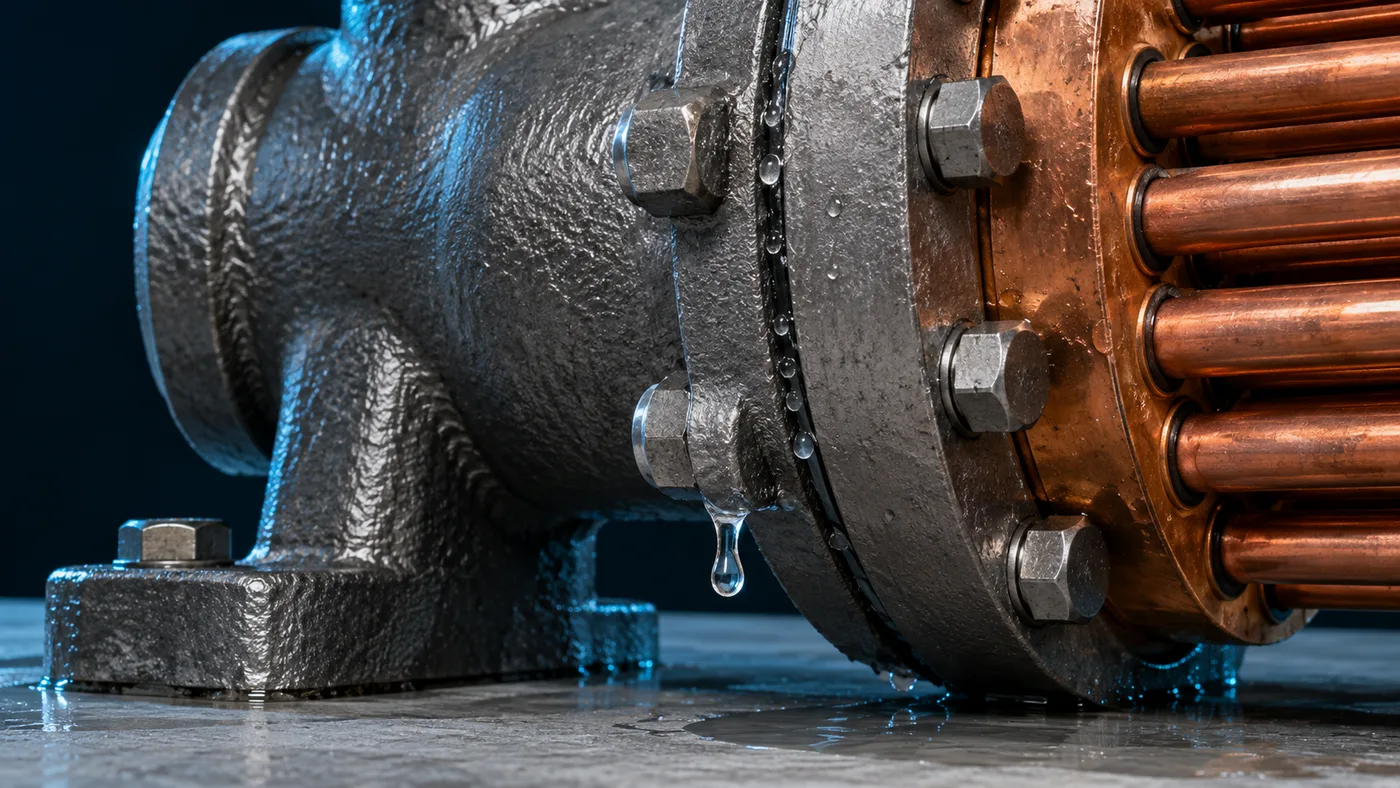
Do this before pricing anything. Isolate the heater, drain it at the header plugs, dry the whole water side with a rag and compressed air, then refill and pressurise with the pump running and the gas off. Watch for ten minutes with a light.
| Where it appears | What it is | Repair class |
|---|---|---|
| A bead along the flange line between header and tube sheet | Flat gasket | Gasket kit |
| A drip from the drain plug boss, or around the plug threads | Plug, bushing or O-ring | Small parts |
| A crack or weep on the header casting itself, often at a bolt boss | Header | Header |
| Green-white crust on the outside of a header, no visible crack | Header corroding from inside | Header |
| Water inside the combustion chamber, or steam at the flue on start-up | Tube bundle | Exchanger |
| Rust streaks running down from the tube sheet onto the burner tray | Tube bundle, already leaking into the fire | Exchanger, and check the tray |
The last two lines are the ones that end the repair conversation and start the replacement one. Everything above them is routine work.
A caution on the third and fourth lines: a header that looks sound can still be finished. Cast iron corrodes from the waterway outward, so the first visible sign is often a stain rather than a crack, and the casting lets go under pressure a month later. If you have the header off and the waterway is scaled, pitted or scabbed, replace it while the heater is open.
Why the exchanger failed — answer this or the new one dies too
A copper tube bundle does not wear out on a schedule. It fails for a reason, and if the reason is still there when the new bundle goes in, the new bundle has the same life expectancy as the old one. There are four causes worth ruling out, and all four are cheaper to fix than the part you are about to sell.
Low flow. An undersized pump, a clogged filter, a closed valve or a plugged impeller means the water in the tubes absorbs more heat per gallon than the design allows. The tubes overheat locally, scale falls out of solution onto the hot spots, and the scale insulates the copper into failure. Check the pressure drop across the heater and the filter before anything else.
Chemistry. Low pH and high salt both attack copper, and they attack it fastest where the water is hottest. Persistent pH below 7.2 will eat a bundle in a couple of seasons. A salt chlorine generator on a heater fitted with a plain copper bundle is a slow-motion version of the same thing.
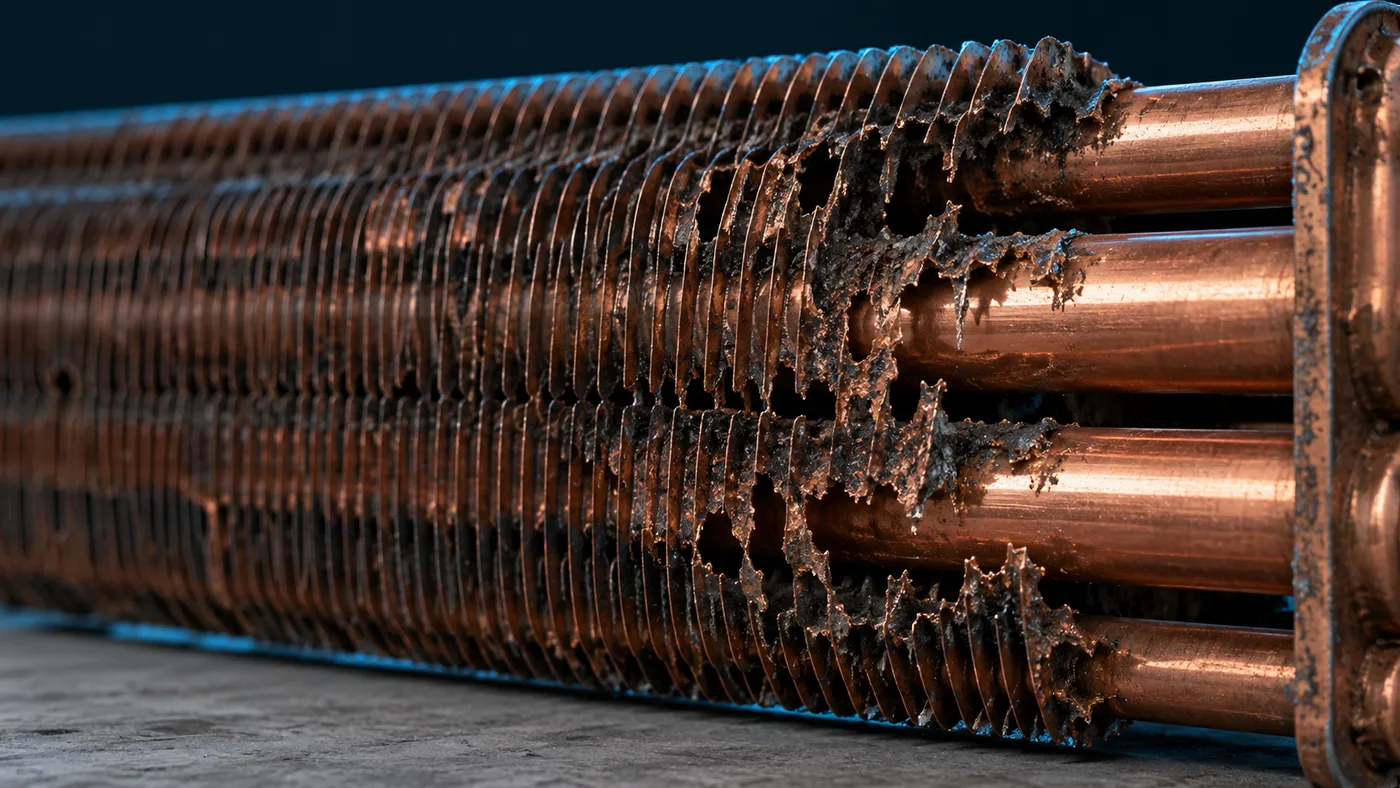
Condensation. This is the one most often missed. If return water enters the exchanger too cold, flue gas condenses on the outside of the tubes, and that condensate is acidic. It eats the fins first — you will see the fin stack thinned or gone on the flue side while the tubes themselves still look serviceable. The heater has a device whose entire job is to prevent this by blending hot outlet water back into the inlet: Raypak calls it the Unitherm governor, Pentair and Sta-Rite call it a thermal regulator or bypass valve, Laars uses a spring-loaded internal bypass. If the fins are eaten and the tubes are not, the bypass failed. Replacing the bundle without replacing the bypass repeats the failure.
Freeze. A split on the underside of a header or a tube that burst outward rather than corroding through is a freeze, not a chemistry failure, and it usually takes the header and the bundle together.
The bypass parts are inexpensive and belong in the same order as the exchanger. On Raypak polymer-header units that is the Unitherm governor 006719F, its spring 850247, the Capron bypass kit 006715F and the Capron drain plug 006721F. On Pentair and Sta-Rite forced-draft heaters it is the thermal regulator and manifold bypass valve kit 77707-0010, or the bypass valve replacement kit 77707-0001. Laars bypass gaskets and springs are covered in the Laars service guide.
Header material: the choice you only get to make during the repair
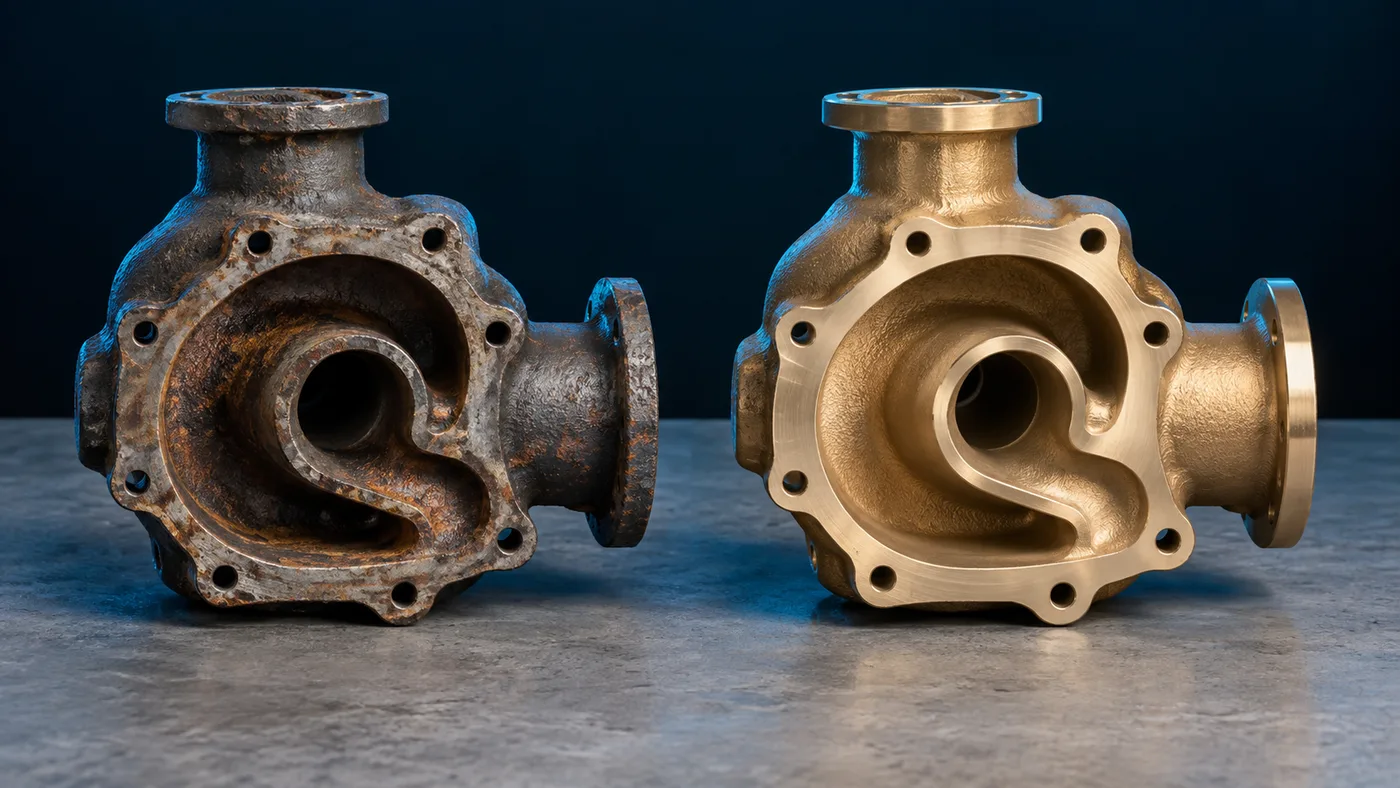
Most of these heaters were sold with a header material chosen on price, and the aftermarket still offers both. A header job is the one chance to change the answer.
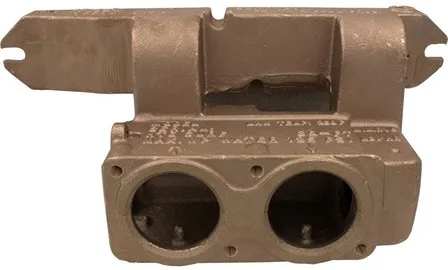
Cast iron is what the cheaper build shipped with. It is strong, it is the least expensive casting, and it corrodes from the inside. On a heater that has already eaten one cast-iron header, fitting another is a decision to do this job again.
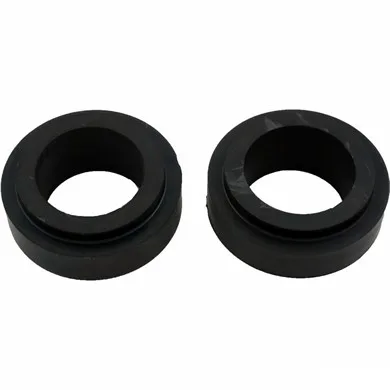
Bronze and brass resist the same water that killed the iron. On a Raypak 185A/265A/335A the inlet/outlet header is offered as cast iron 003759F or bronze 003760F — same heater, same bolt pattern, different service life. The same fork exists on the 155B/C, where the inlet/outlet header is 004963F in cast iron or 004887F in bronze, and the return header is 004964F in cast iron or 004888F in bronze. Return headers on the older 181/261/331/401 are 002450F in cast iron and 002451F in brass.
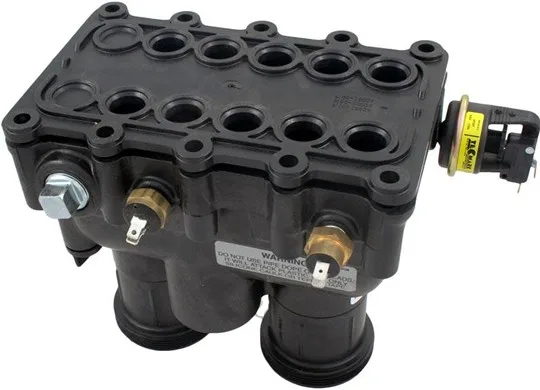
Capron and polymer are what Raypak moved to on the later digital units, and they neither corrode nor scale. The Capron inlet/outlet header kit 006827F covers R185A/R265A/R335A; the cast-iron ASME equivalents for the same heaters are 006730F and 006731F. On Pentair, the main header manifold 070985 covers thirteen models on its own.
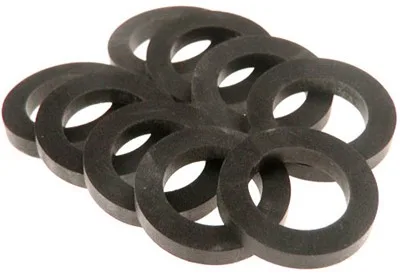
Flange gaskets go back with every header: 062236B for the 1½-inch bronze flange, 800014B for the 185A/265A/335A flat gaskets in a nine-pack, 800075B for the 151/153/155A Versa family, and the header baffle kit 006826F on the R185.
Tube bundle material: copper or cupro-nickel
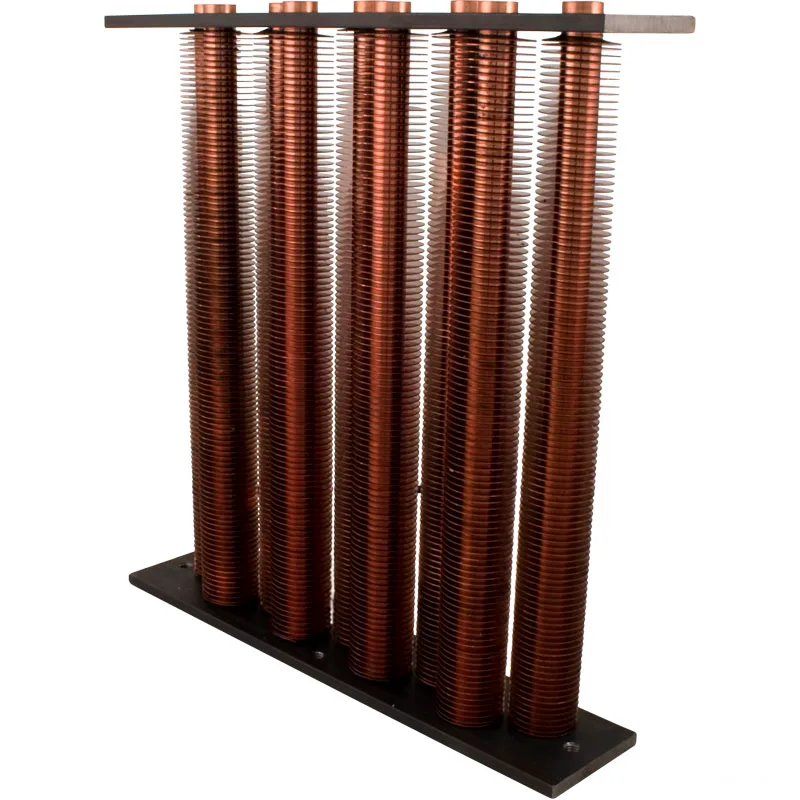
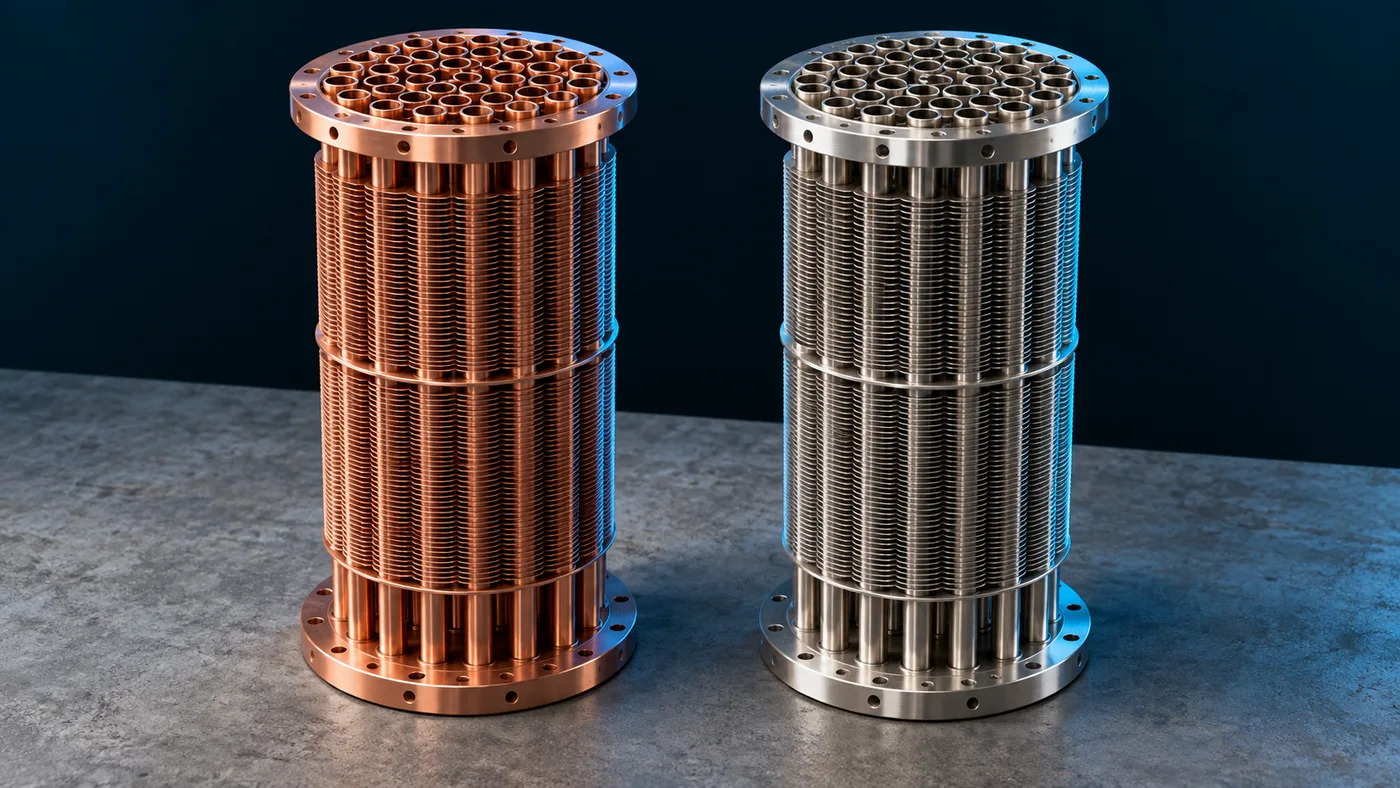
The material question repeats one level down, and it matters more. Standard bundles are copper. Cupro-nickel costs more and resists salt and aggressive chemistry far better — for a pool on a salt chlorine generator, or water that has already killed one bundle, it is the only sensible specification.
The pairs are direct substitutions on most Raypak families:
| Heater | Copper | Cupro-nickel |
|---|---|---|
| 206A / 207A | 010055F, 010059F |
017978F |
| 265 / 266 / 267 | 010060F |
010365F |
| CR265A / PR266 / 277A | — | 010369F |
| 336A / 337A | 010057F, 010061F |
010370F |
| 406A / 407A | 010058F, 010062F |
010371F |
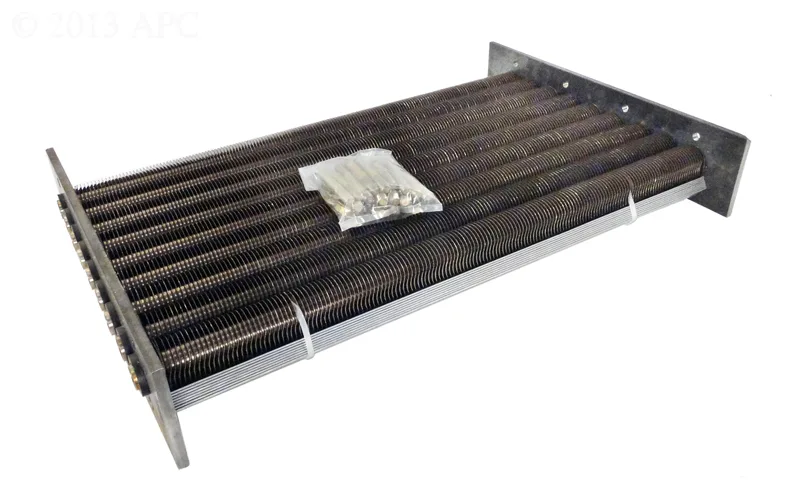
For the millivolt and Versa families the bundles are copper only: 004671F (183/183A), 004672F (263/263A), 004673F (333/333A/335A), 004674F (403/403A), 002439F (151/153/155A), 004896F (155B), 004694F (055B), 011597f (130A). The RP2100 series takes 005252F (185), 005253F (265), 005254F (335) and 005255F (405); 005256F covers the R185 tube. ASME-stamped assemblies are separate part numbers — 006733F, 006734F for R335A/R335, 006735F for the R405B — and are not interchangeable with the non-ASME versions on a job where the stamp is required.
On the Pentair side the exchanger is usually quoted with or without heads. Without heads: 472131 (150,000 BTU), 75628 (200,000), 075629 (300,000), 75630 (350,000), 472136 and 74074 (400,000), 74451 (250,000), 74452 (150,000 MiniMax). For the CH series, 472132 (CH200), 472133 (CH250) and 472134 (CH300) come without headers, while 472167 is the CH250 complete with headers. 474063 is the tube sheet coil assembly for the 250HDNA and 250HD-LP MasterTemp, 460747 the 250K assembly, and 70277 the exchanger baffle for the MiniMax 350K, CH150 and CH350. The exchanger bolt is 471622. Manifold work on Max-E-Therm SR333 uses 77707-0015. Laars exchanger baffles are 10697401 (125,000), 10697403 (250,000) and 10697404 (325,000).
Model coverage for these is on the Raypak 406A, 266A, R405, R335, RP2100, Versa, MasterTemp, Max-E-Therm, MiniMax Plus and MiniMax CH pages.
Scaled, not finished: when a bundle can still be saved
Scale is the one exchanger fault that is sometimes reversible, and it is worth ten minutes of looking before it is worth a bundle.
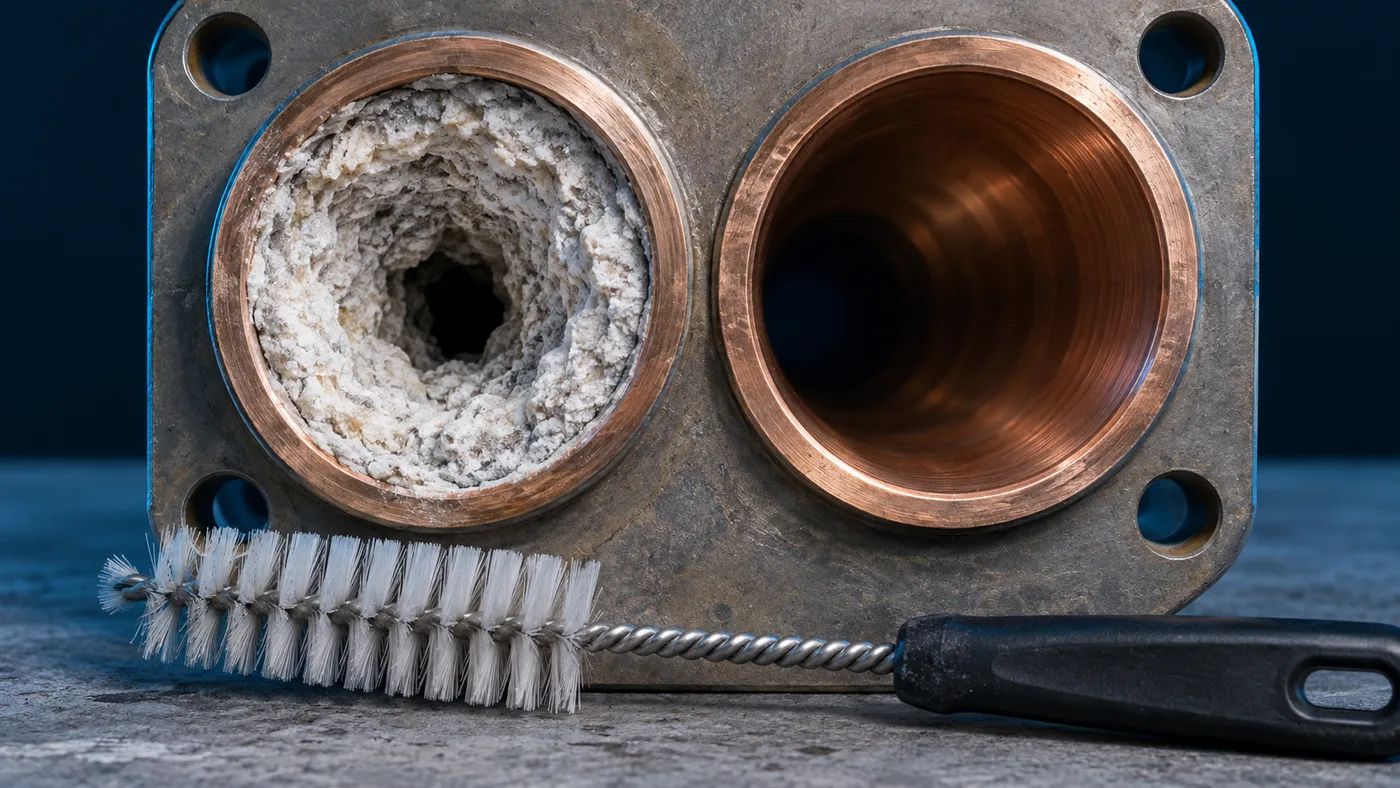
Pull the header and look into the tube ends. A thin white film that a nylon brush takes off is housekeeping. A hard grey-white deposit that narrows the bore, or tubes you cannot see daylight through, is restricting flow badly enough to cause the next failure even if nothing is leaking yet. Between those two is the judgement call, and it turns on three things.
Is the copper underneath sound? Descaling removes the deposit, not the metal. If the scale is hiding pitting or a tube that has already been thinned, taking the scale off reveals a leak rather than fixing one. Assume this is the outcome on any bundle that has run with low pH.
Is the deposit calcium or is it corrosion product? Calcium scale is chalky and white-grey and dissolves in acid. Green or blue-green deposit is copper that has already gone into solution and come back out — that is chemistry attack, and the bundle is on a timer regardless of how well it cleans up.
Will it happen again? A bundle that scaled because of high calcium hardness and a heater with no bypass working will scale again in the same number of seasons. Descaling buys time only if the cause has been dealt with.
Where a clean-up is worth doing, it is a tank job with a proper heat-exchanger descaler, not acid down the plumbing — circulating acid through the pool side puts it through the pump seal, the filter and every gasket in the loop. Re-gasket on reassembly regardless: 800014B on the 185A/265A/335A families, 800075B on the Versa 151/153/155A, 062236B for the 1½-inch bronze flange. If the heater is coming apart anyway, the incremental cost of fitting new headers while it is open is mostly labour you have already spent.
One thing descaling does not fix: fins eaten from the flue side. That damage is on the outside of the tubes, it is condensation, and no cleaning brings it back.
When the heater itself is the answer
Three conditions each point at replacement on their own, and any two together settle it.
The exchanger and a header have both failed. At that point you are rebuilding the entire water side of a heater whose combustion side is the same age. The parts total approaches a new unit before labour.
The gas train, ignition or control parts are no longer available. Gas valves, burners, sensors, switches, igniters and control boards are OEM-only — we do not supply them, for the reasons set out in our piece on where aftermarket parts should stop. A heater that cannot be returned to a certified condition is not a repair candidate no matter how good the water side is. Check availability of the specific board or valve before ordering anything else.
The heater is atmospheric and the customer is paying to run it. An old natural-draft heater at 78 to 82 percent thermal efficiency against a current low-NOx unit at 84 to 95 percent is a running-cost argument that gets stronger every season. On a pool heated four hours a day the difference pays for a large part of the new unit over its life; on a spa used ten times a winter it does not, and the repair is right.
What does not settle it: age alone. A twenty-year-old Laars with a sound bronze header and a clean bundle is worth servicing. Bright copper with intact fins, or fins that clean up with a brush, is a heater worth working on.
What we supply and what must come from the brand
Everything in this guide is water-side and structural: heat exchangers and tube bundles, headers and manifolds, bypass and thermal-regulator parts, gaskets, plugs, baffles and hardware. Burner trays are supplied bare — 005265F (R185), 005266F (R265), 005267F (R335) and 005268F (R405) are trays without burners and without the manifold.
Gas valves, burners, orifices, gas manifolds, igniters, pilot assemblies, high-limit and pressure switches, flame sensors, thermistors and control boards are OEM-only. We do not stock them and will not source them. Anything that has to act when something goes wrong belongs to the equipment brand and its certification.
Sourcing
Heat exchangers and headers are the heaviest and most expensive line in the heater category, which is why so many distributors carry the gaskets and none of the castings — and why a service company can wait three weeks for a bundle in July. We carry the water side across Raypak, Pentair, Sta-Rite and Teledyne Laars: 70 exchanger and tube bundle lines and 57 header and manifold lines, in cast iron, bronze, brass, Capron and cupro-nickel, ASME and standard.
If you are quoting a rebuild, send the heater model and the serial plate along with what you found on the flange line, and we will come back with the bundle, the matching headers, the gasket set and the bypass parts as one list — including the material substitution, if the water that killed the first one is still in the pool.