
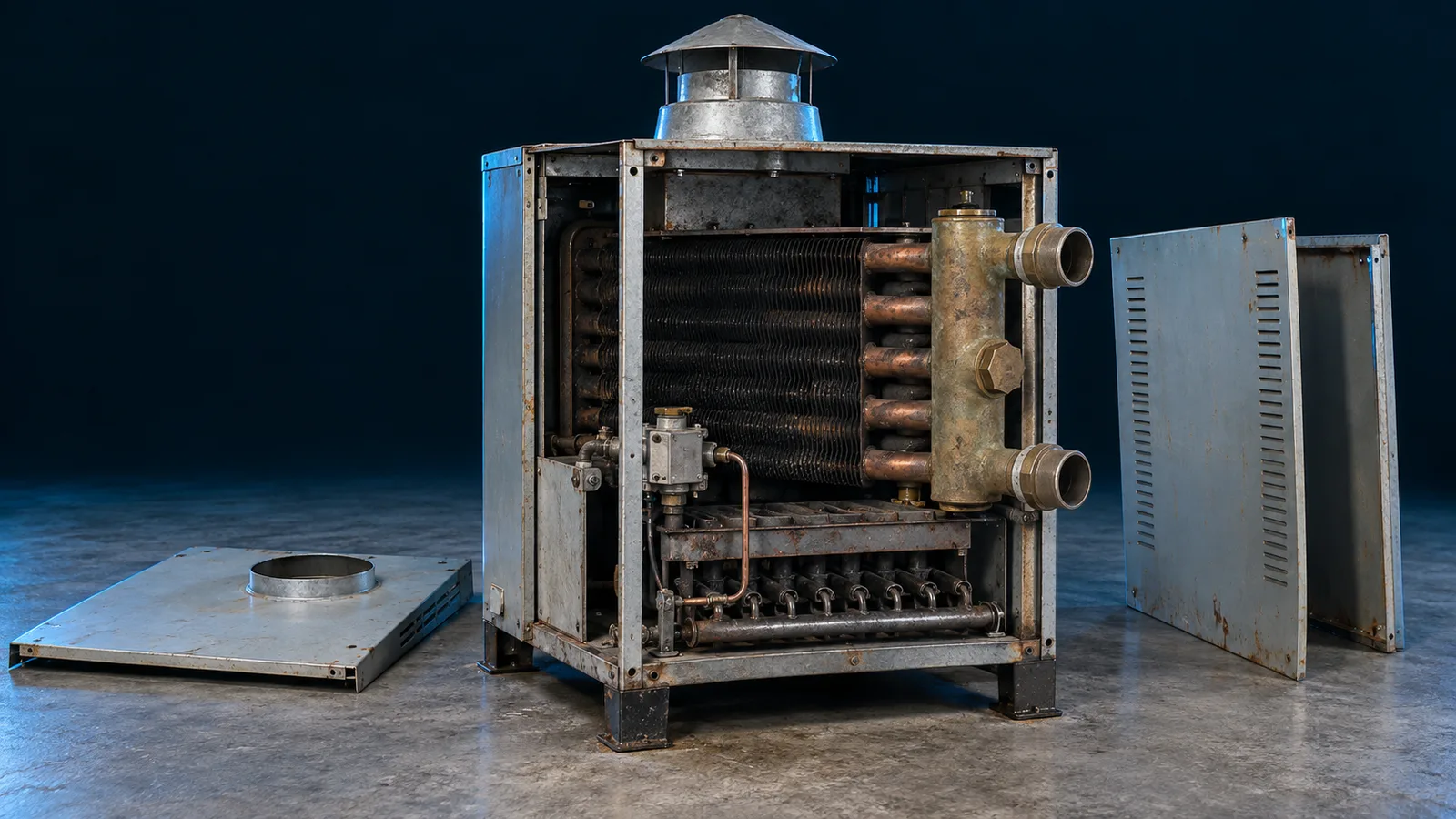
There is a reason a Teledyne Laars heater turns up on so many service calls: the company sold them for decades, under its own name and then under Jandy's, and a cast-bronze header on a copper tube bundle does not die of old age. What does die is everything around it — the vent cap that rusted through, the bypass gasket that finally let go, the blower whose bearing gave up in its fifteenth season. A service company that knows which of those parts still exist, and which do not, can keep a Lite2 or an LX earning its keep long after the brand has moved on to the next model.
This guide covers the four families you are most likely to meet: the atmospheric Lite2, the first low-NOx LT and LX, and the LXi that replaced them. It is organised the way a repair actually goes: identify the heater, decide whether it is worth the visit, then work through the water side, the venting and the blower. Gas-train, ignition and control parts are listed at the end as OEM-only, for the reasons set out in our piece on where aftermarket parts should stop.
Which heater you have
The rating plate is behind the front access panel on all of them; if it is unreadable, the shape of the cabinet and the presence or absence of a blower tell you most of what you need.
| Family | Era (approximate) | Combustion | Ignition | What it looks like |
|---|---|---|---|---|
| Series 2 ESG / ESC | 1990s | Atmospheric, natural draft | Millivolt (standing pilot) or electronic | Square steel cabinet, bronze headers on the left, draft hood on top |
| Lite2 (LG / LD / LJ) | 1990s to early 2000s | Atmospheric, natural draft | LG millivolt; LD digital electronic; LJ hot-surface | Same cabinet lineage as Series 2, plastic control panel, stack draft hood or outdoor vent cap |
| LT / LX | 1999 to 2007 | Low-NOx, forced draft | Electronic, hot-surface igniter | Blower on the side, front and rear headers, no visible open flame |
| LXi | 2008 to mid-2010s | Low-NOx, forced draft | Electronic with LED diagnostics | Larger blower assembly with gaskets, polymer front header, digital display; superseded by the JXi |
The atmospheric units burn with a tall open flame under a natural-draft hood; the low-NOx units burn a short flame with air pushed through by a blower, which is why LT/LX/LXi service calls so often begin with an air-flow fault and Lite2 calls begin with a pilot. Our catalogue has the deepest coverage on the Lite2 and its LJ variant, the LT, LX and LXi, and on the Series 2 ESG that shares its water side with the Lite2.
Prep and safety
Power off at the breaker, gas off at the manual valve upstream of the heater, and let it cool. On the forced-draft units, the blower housing and the vent collar stay hot well after shutdown. Close the isolation valves and drain the exchanger at the header plugs before pulling a header — a 400,000 BTU exchanger holds more water than the pad drain wants to see at once.
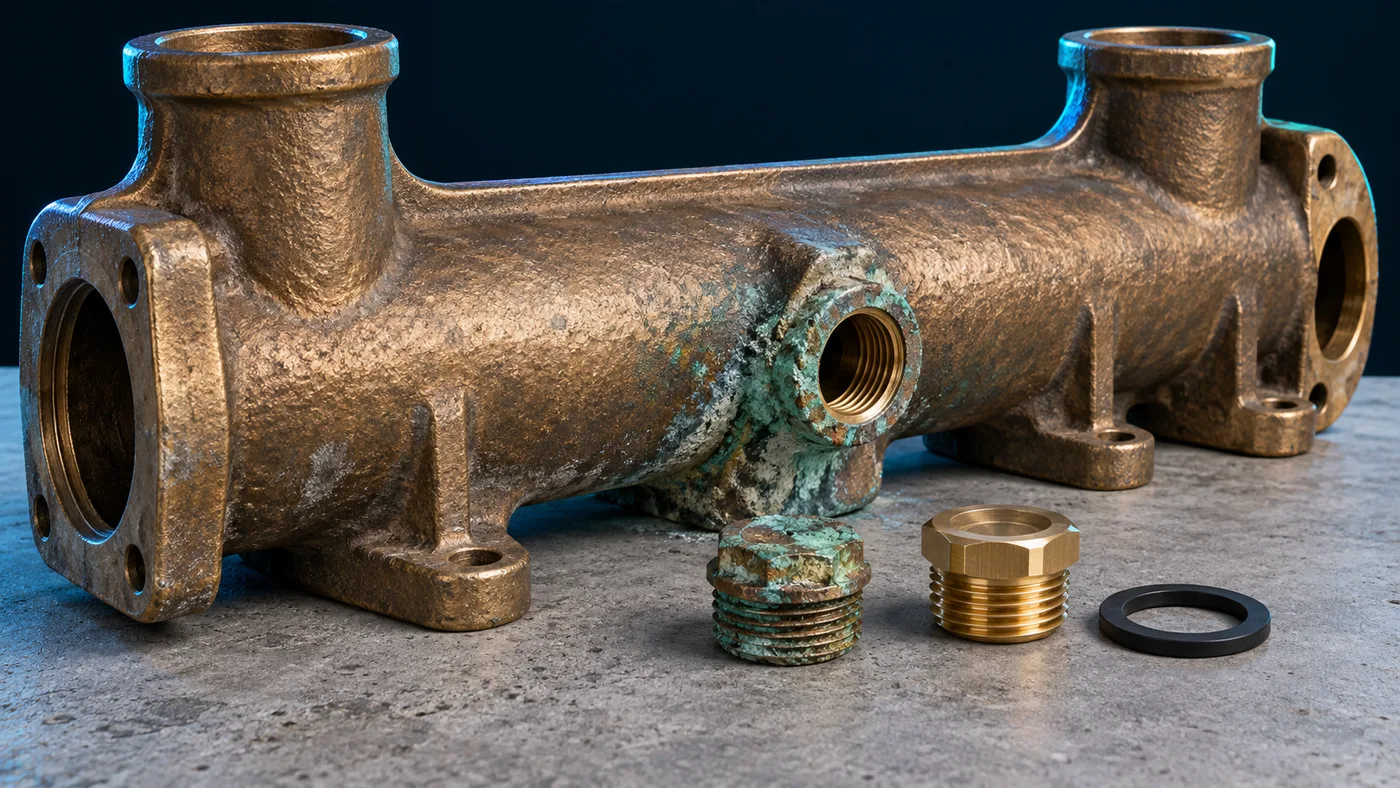
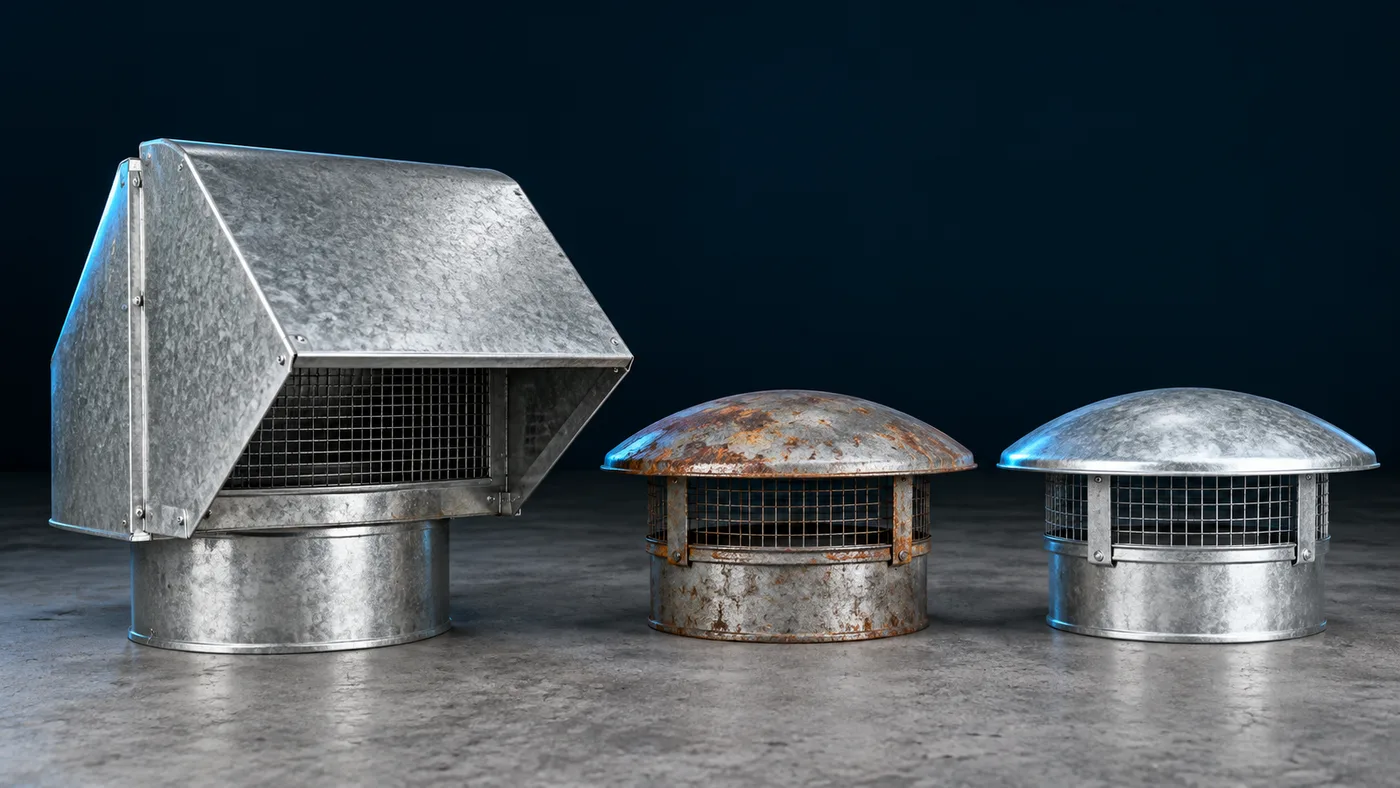
Before you open anything, look at the outside of the heater for the two things that decide the whole call: rust streaks or white mineral tracks running down from the headers, and the condition of the vent. A streaked header means the water side is already leaking; a collapsed or rusted-through vent cap on an atmospheric heater means it has been breathing badly and the exchanger fins are probably sooted.
Is this heater worth saving?
A twenty-year-old heater is not automatically a write-off, but the decision should be made at the start, not after three visits. Work through three questions.
Is the exchanger sound? Pull the front header or the draft hood and look at the tube bundle. Bright copper with intact fins, or fins that clean up with a brush, is a heater worth working on. Fins eaten away by condensation, green corrosion across the tube sheet, or a tube that has already been soldered once are not. On the LXi, where the exchanger comes as a complete assembly, a bad bundle can still be a replacement decision because the part exists; on the older units it usually ends the conversation.
Are the control parts still available from the brand? Ignition controls, boards and gas valves for these families are OEM-only. If the specific board or valve is no longer stocked, the heater cannot be brought back to a certified condition no matter how good the exchanger is. Check before you order the header gaskets.
What is the customer running it for? A spa heater used ten times a winter and a pool heater running four hours a day carry different economics. The first can justify a header and a bypass rebuild; the second may not.
If the exchanger is sound and the controls are available, the rest of this guide is the repair. If either fails, price the replacement and stop.
Headers, bypass and gaskets: where the water shows up
The water side is where these heaters actually wear, and it is where the aftermarket does its most useful work: bronze and polymer headers, bypass assemblies, gaskets, plugs and the small hardware that seizes.
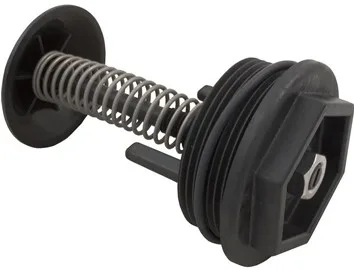
Atmospheric units (Series 2, Lite2). The inlet/outlet header and the return header are bronze castings bolted to the tube bundle with flat gaskets. Leaks show as a green-white crust at the gasket line or a steady drip from the drain plug boss. Flat gasket failure is a re-gasket job; a header cracked at a bolt boss or eroded at the port is a header. Our range covers the 2-inch inlet/outlet header R0016800 and R0056400, the 9-hole return headers R0054600 and R0058300, header bolts F0046100 and the bolt kit R0057000, the brass inlet/outlet header plug P0027000 and return drain plug P0026800, plus the drain plug bushing P0018500 and grommet R0316300 that are always lost during the job. The internal bypass on these units uses a spring-loaded valve whose gasket R0011400 hardens with age; the springs are colour-coded to the heater's BTU rating (S0079900 purple 125, S0061400 and S0061300 for the 175 and 250, S0061200 blue 250/325, S0070100 black 400), and the bypass rod kit R0391800 and cap bolt F0041600 complete the rebuild. The siphon loop R0057800 on the Lite2 corrodes through from the inside and is a common source of a leak that looks like a header problem.
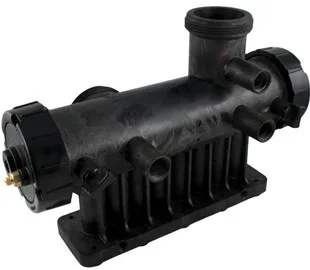
LT and LX. Here the water enters through a front header and returns through a rear header, each with its own gasket set and hardware. Our front header R0326900 and rear header R0327000 come with hardware and gaskets; the bypass assembly R0327100 includes its gasket, with the gasket alone as R0336700 and the spring as R0327200. The coupling nut kit R0327300 and the siphon loop R0334600 are the two parts most often found seized or corroded when the header comes off.
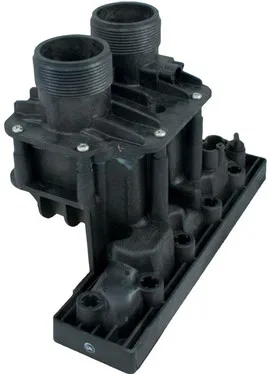
LXi. The LXi moved to a polymer front header, and the failure mode changed with it: instead of a corroded casting you see a header that has crazed around a port or a return cap whose O-ring has flattened. Our front header R0453600 ships with hardware and gaskets, the return header cap with O-ring is R0454600, the bypass spring R0453900, and the sensor and pressure-switch cap with O-ring R0455400 seals the wells that the OEM sensors screw into.
A note on gaskets across all four families: reuse nothing. A header gasket that has been compressed for fifteen years has taken a set and will weep at the first thermal cycle. The temperature sensor gasket R0456600 and the Lite2 sensor bulb gasket E0116400 fall into the same category — replace them whenever the sensor is disturbed, even though the sensor itself is an OEM part.
The heat exchanger
Scale inside the tubes and soot on the fins are the two slow killers, and both come from the same place: water that runs too cool through the exchanger. That is what the bypass is for, and a bypass with a tired spring or a leaking gasket lets the exchanger run below the dew point of the flue gas, so acidic condensate drips onto the fins and the tube bundle rots from the outside in. If you find a sooted or corroded bundle, rebuild the bypass at the same time, or the new exchanger will go the same way.
For the atmospheric units the exchanger is a tube assembly: R0018101 for the 125,000 BTU, R0018103 for the 250, R0018104 for the 325 and R0018105 for the 400. For the LXi it is a complete copper exchanger: R0453303 for the 250, R0453304 for the 300, R0453305 for the 400, with R0453405 supplied as the 400 assembly with hardware and gaskets, and the end baffles R0453505 that are usually crushed on removal.
The Series 2 ESG page lists the full tube assembly range with the header parts that go on with it.
Venting: draft hoods, vent caps and collars
On an atmospheric heater the vent is part of the combustion system. A draft hood that has rusted at its seams or a vent cap that has collapsed changes the draft, and a heater with bad draft soots its fins and rolls out flame. On the Lite2 our range covers the indoor draft hoods (10561402 6-inch for the 175, 10561405 9-inch for the 400) and the outdoor vent caps by diameter: 10561501 5-inch, 10561502 6-inch for the 175, 10561503 7-inch for the 250, 10561504 8-inch for the 325, 10561505 9-inch for the 400. The draft hood and vent cap adapter plate R0449703 fits the 250 Lite2 and LJ. Match the diameter to the heater, not to whatever pipe happens to be on the roof — an undersized cap is the most common cause of a "new" sooting problem after a vent repair.
On the LT and LX the indoor vent collar R0331403 and the 9-inch collar R0331405 seal the blower discharge to the vent; the outdoor grill R0328500 protects the intake. Cracked collars leak flue gas into the cabinet and are a safety fix, not a cosmetic one.
Blowers: LT, LX and LXi
The forced-draft units prove combustion air through a blower and a pressure switch; when the blower slows, the switch will not close and the heater faults on air flow. On the LXi the control board shows this as a single LED flash; on the LT and LX it is an air-flow lockout at the ignition control. Before condemning the blower, check the small silicone tube from the blower to the pressure switch for water, cracks and wasp nests, and check the vent for obstruction — a blocked vent looks identical to a dead blower from the switch's point of view.
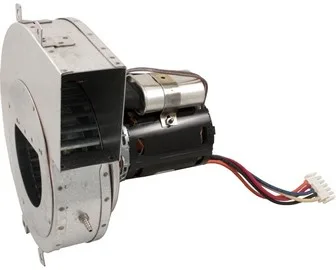
A blower that hums without turning, squeals from a bearing, or trips the switch intermittently as it warms up is a replacement. The blower assembly for the LT and LX is R0329800; for the LXi it is R0455600, which ships with its gaskets. Do not reuse the blower mounting gaskets on either — an air leak at the blower flange skews the pressure the switch is reading and will bring the fault straight back.
What is aftermarket work and what is OEM-only
OEM-only: ignition control modules and boards, hot-surface igniters and pilot assemblies, flame sense rods, gas valves and burner manifolds, high-limit switches, water pressure switches, air pressure switches, fusible links, temperature sensors and the LXi display and membrane pad. Every one of these either meters gas or shuts the heater down when something is wrong, and its failure mode is part of the appliance certification. If the brand no longer stocks one for your heater, the heater is at the end of its life.
Aftermarket work: headers (bronze and polymer), bypass assemblies, springs, rods and gaskets, header plugs, bolts and hardware, siphon loops, heat exchanger tube assemblies and complete exchangers, draft hoods, vent caps, vent collars and grills, blower assemblies and their gaskets, sensor wells, sleeves, caps and sensor gaskets, burner tray shelves (R0317001 through R0317005 — the steel shelf, not the burners), control covers, bezels and knobs. These are the sealing, structural and flow parts that wear; replacing them does not alter how the heater proves flame or shuts itself down.
Parts table by heater family
These heaters predate the cross-reference habit, so most of these numbers are the original Laars or Jandy numbers themselves; the two with alternate references are noted.
| Family | Part | POOLPOINT number | Notes |
|---|---|---|---|
| Series 2 / Lite2 | Inlet/outlet header, 2-inch bronze | R0016800, R0056400 |
With hardware on R0056400 |
| Series 2 / Lite2 | Return header, 9-hole | R0054600, R0058300 |
Bronze |
| Series 2 / Lite2 | Header plugs | P0027000, P0026800 |
Inlet/outlet and return drain |
| Series 2 / Lite2 | Bypass gasket, springs, rod, cap bolt | R0011400, S0079900–S0070100, R0391800, F0041600 |
Springs by BTU rating |
| Series 2 / Lite2 | Siphon loop | R0057800 |
Lite and Lite2 |
| Series 2 / Lite2 | Heat exchanger tube assembly | R0018101, R0018103, R0018104, R0018105 |
125 / 250 / 325 / 400 |
| Lite2 | Draft hoods | 10561402, 10561405 |
6-inch 175, 9-inch 400 |
| Lite2 | Outdoor vent caps | 10561501–10561505 |
5- to 9-inch by rating |
| Lite2 / LJ | Draft hood adapter plate | R0449703 |
250,000 BTU |
| Lite2 | Sensor bulb gasket, protector sleeve | E0116400, 10444900 |
Sensor itself is OEM |
| LT / LX | Front and rear headers | R0326900, R0327000 |
With hardware and gaskets |
| LT / LX | Bypass assembly, gasket, spring | R0327100, R0336700, R0327200 |
|
| LT / LX | Coupling nut kit, siphon loop | R0327300, R0334600 |
|
| LT / LX | Blower assembly | R0329800 |
|
| LT / LX | Vent collars, outdoor grill | R0331403, R0331405, R0328500 |
|
| LXi | Front header, return cap | R0453600, R0454600 |
Polymer header with gaskets |
| LXi | Bypass spring, sensor/pressure switch cap | R0453900, R0455400 |
|
| LXi | Complete heat exchanger | R0453303, R0453304, R0453305, R0453405 |
250 / 300 / 400; R0453405 with hardware |
| LXi | Heat exchanger end baffles | R0453505 |
400 |
| LXi | Blower assembly with gaskets | R0455600 |
|
| All | Temperature sensor gasket | R0456600 |
Also referenced as Jandy R0456500, R0477300, R0523900 |
| Millivolt units | On-off switch | R0094100 |
Referenced as Laars 6600-6699 |
Sourcing
POOLPOINT manufactures the headers, bypass components, gaskets, vent parts, blowers and exchangers above factory direct for US distributors, service companies and online sellers. MOQ starts at 50 pieces per SKU, mixed cartons are accepted to reach it, and private label is available. We do not supply gas-train, ignition or safety components for any heater. Request a quote for wholesale pricing on the parts we do make.