

Packaging gets treated as the last decision in a sourcing project, which is odd given that it determines a large share of landed cost, most of the damage rate, and whether the part can be listed on a marketplace at all. It is also one of the few things you can change without changing suppliers.
Start with the carton, not the retail pack
Freight for most part categories is charged on volumetric weight — the space the shipment occupies, not what it weighs. So carton efficiency is a direct cost line, and it is decided before anyone thinks about branding.
Two orders, identical goods:
- Thirty part-full cartons, one per SKU, no mixing
- Twelve full cartons with mixed contents
Same pieces. Materially different freight. This is why "can cartons be mixed" is a costlier question than the unit price on a multi-SKU order.
What to specify per part:
Pieces per inner pack
Inner packs per carton
Carton external dimensions
Gross and net weight
Ask for these on the quotation, not after. Without them you cannot calculate freight and cannot compare two suppliers honestly.

Bag or box: pick per part, not per range
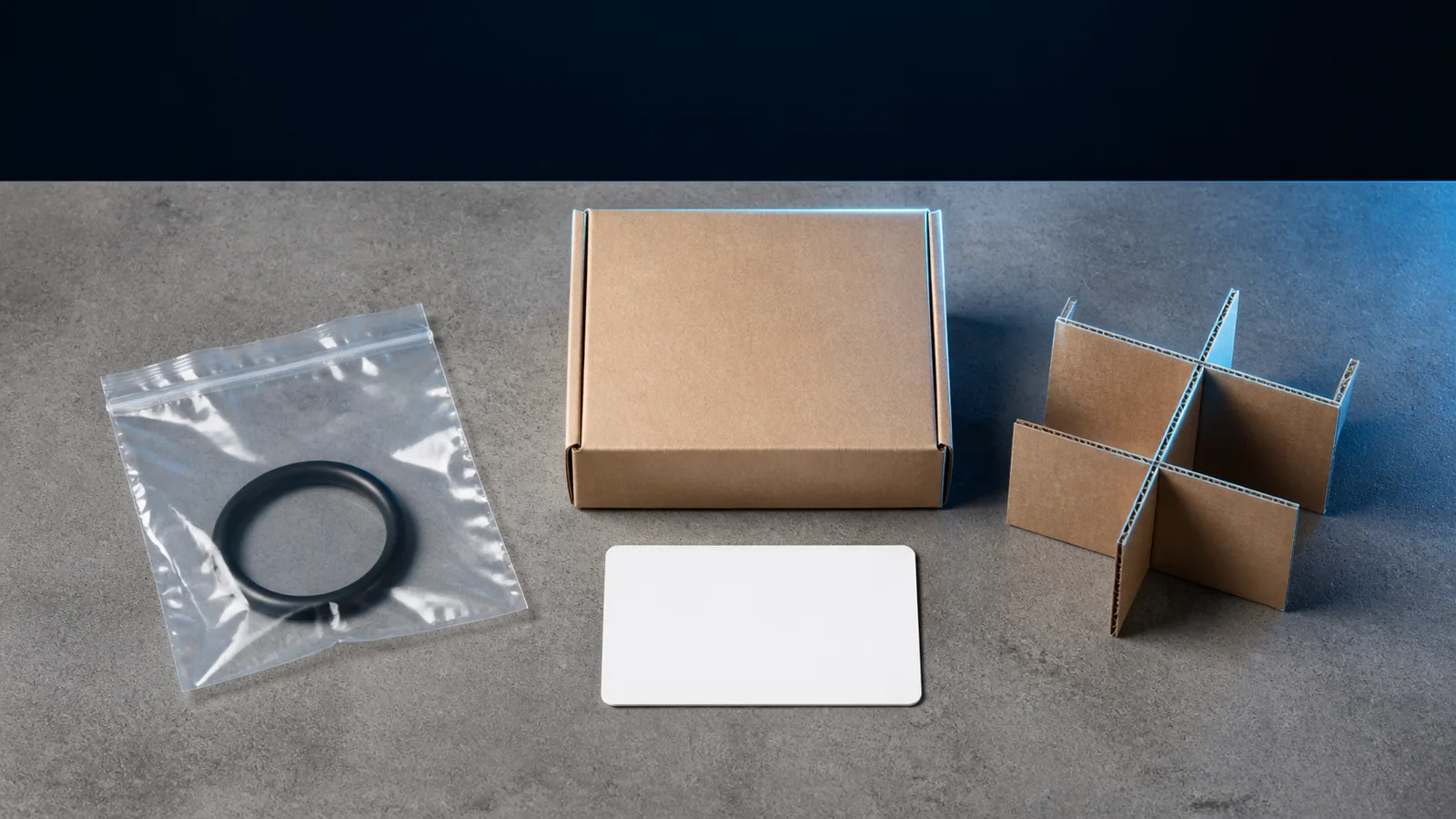
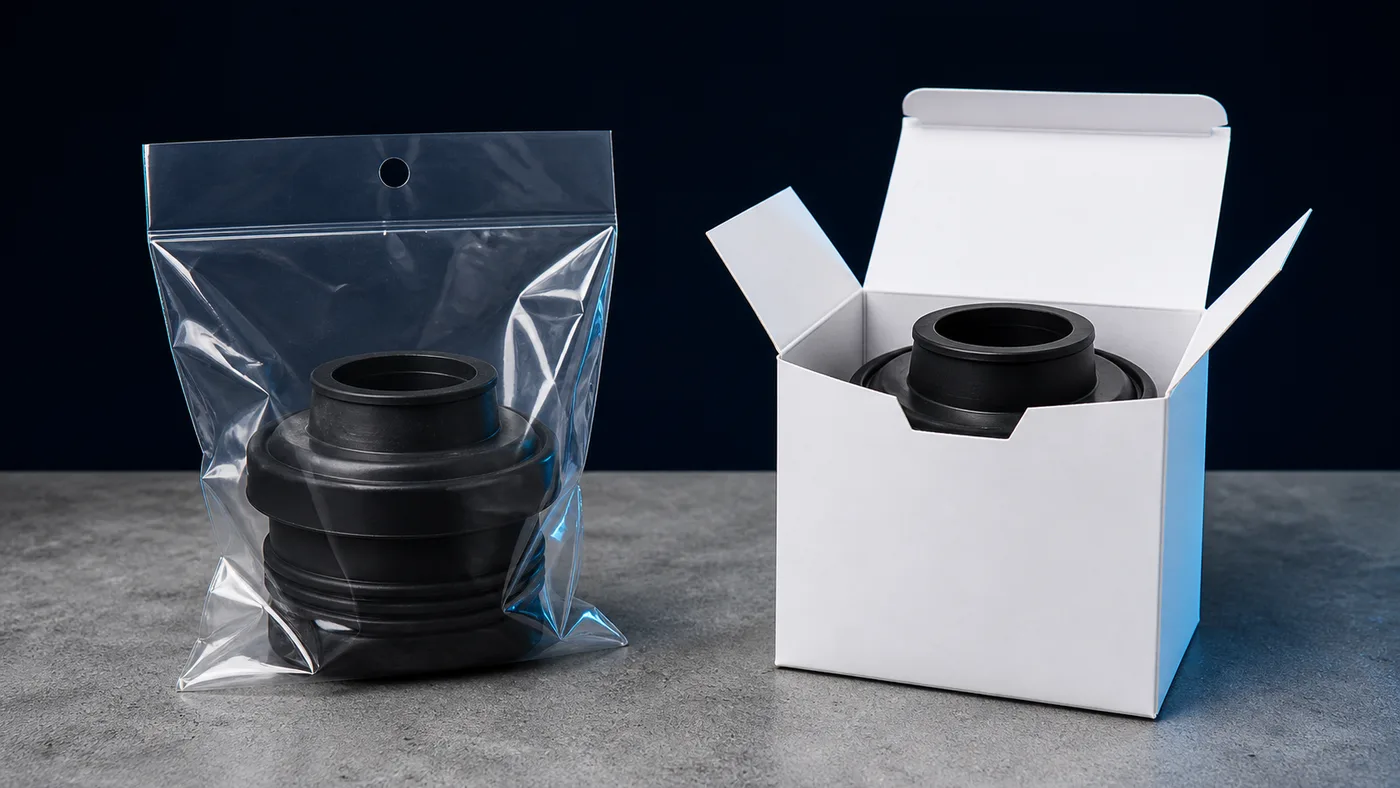
Polybag — cheapest, lowest volume, minimal protection. Right for o-rings, gaskets, small hardware, anything that cannot really be damaged by compression. Add a header card if it needs to hang on a rack.
Folding carton — protects, presents, stacks. Right for anything with a projecting feature that can snap, anything sold at retail, anything a customer sees before buying.
Bulk with dividers — right for volume shipments to a distributor who repacks anyway. Wasteful to individually box a part that is going to be picked out of a bin.
Most ranges want a mix. A supplier who packs everything the same way has made one decision for the whole catalogue, and it is wrong for part of it.
What has to be on the label
Non-negotiable:
- Your brand and your part number
- What the part is, in plain words
- Quantity
- Country of origin
- Barcode, if it will be scanned anywhere
- The disclaimer
Worth including:
- The OEM numbers it replaces, phrased as replacement rather than equivalence
- Material, where it matters to the buyer
- What it fits, if that is short enough to be useful
Do not include: any equipment manufacturer's logo, the word "genuine", or certification marks the part does not carry.
The disclaimer wording should be boring and consistent — an independent manufacturer, not affiliated with or endorsed by the equipment brand, brand names and OEM numbers used to identify fitment only. Put it on every pack, not just the ones organised around a brand name.
Barcodes: get this right once
If your parts will ever be scanned — by a marketplace, a distributor's WMS, or your own warehouse — you need real barcodes, which means your own GS1 prefix. Numbers bought from a reseller work in some systems and are rejected by others, and discovering which after printing 20,000 labels is expensive.
Two rules that prevent the most common mess:
One barcode per sellable unit. If you sell singles and a pack of ten, that is two barcodes.
Never reuse a barcode across parts. Even after a part is discontinued. Reused codes surface as mis-picks years later.
Instruction sheets: when they earn their cost
For most pool parts, an instruction sheet is unnecessary — the buyer is a professional replacing a part they have replaced before.
They earn their place in three cases: parts where installation order matters and getting it wrong destroys the part; parts where a lubricant type matters (silicone on EPDM, never petroleum); and parts where fitment depends on identifying a revision, so the sheet tells the installer how to check before they cut anything.
If you include one, keep it to a single side. A folded four-page sheet in six languages is packaging cost with no reader.
Two things that quietly cost money
Over-packing. A polybagged o-ring inside a folding carton inside a divider is three layers of cost protecting something that could not be damaged in the first place. Every layer is material, labour and volume.
Under-packing. Moulded parts loose in a carton with no divider arrive with hairline cracks that are invisible until the part is pressurised — which is a return that looks like a quality problem and is actually a packing problem.
The way to find the right point is to ask the supplier what damage rate they see on that part and how it is packed, and then to inspect what actually arrives.
What to ask for before you commit to artwork
- Dielines for every pack format you will use
- Carton specification per part, in writing
- Packaging MOQ — usually higher than part MOQ, and it decides your commitment
- Who holds the artwork files and who pays for a re-run if something is wrong
- Whether they will pack mixed cartons and how it is labelled
That last one is worth pushing on. A mixed carton with no packing list is a receiving problem every time it arrives.
Sequence
Do not commission packaging before the parts are validated and have sold through one cycle under standard labelling. Custom packaging is the least reversible spend in a private-label programme — you cannot repurpose 5,000 printed boxes for a part that turned out to have a fitment problem.
Validate, sell, then brand.
Sourcing
POOLPOINT quotes carton dimensions and weights with every quotation so you can calculate freight yourself, and accepts mixed cartons to reach the order minimum. Box, label, bag and instruction sheet can all be customised, and we will tell you the packaging minimum before you commit to artwork. MOQ stays at 50 pcs per part regardless of pack format.