

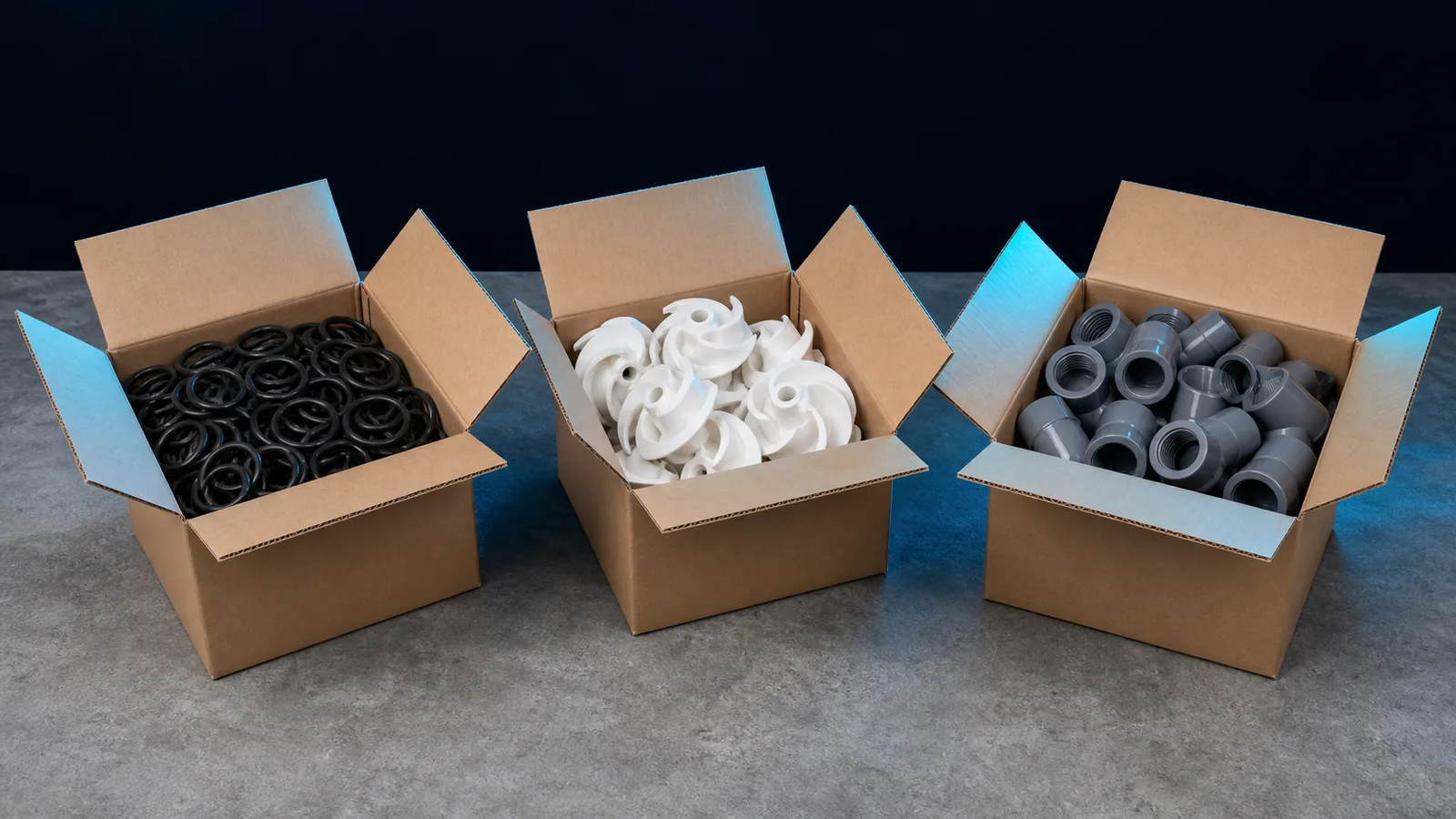
Two suppliers quote "MOQ 50". One means fifty pieces of each part number, in its own carton, with no mixing. The other means fifty pieces per part with cartons combined freely to reach an order minimum. For a distributor bringing in thirty part numbers, those are not similar offers — they are different businesses.
The three things MOQ can be attached to
Per SKU. The most common form. You must take at least N pieces of each part number you order.
Per order. A minimum total, usually expressed in value. Spread across as many SKUs as you like.
Per carton or per production run. The one that catches people out. A factory may accept 50 pieces per SKU but ship each in its own standard carton, so a thirty-SKU order arrives as thirty part-full cartons, and you pay volumetric freight on air you did not order.
Ask which of the three applies. Ask it plainly, because a supplier answering "MOQ 50" is answering a different question than the one you asked.

Why mixed cartons matter more than the headline number
Consider bringing in thirty part numbers to test a range.
At 50 pieces per SKU with mixed cartons, you commit to 1,500 pieces total and can pack them efficiently — a range trial at a manageable cost.
At 50 pieces per SKU with no mixing, the piece count is identical but you now have thirty separate cartons, most of them half empty. Volumetric weight, not actual weight, decides your freight cost. The same order can cost meaningfully more to ship, and the difference has nothing to do with the goods.
So the question that actually determines your cost is not "what is the MOQ" — it is "can cartons be mixed". Ask it in the first email.
Why factories set an MOQ at all
Understanding the reason makes the negotiation easier.
For a moulded part, every production run has a fixed setup cost: the tool goes into the press, the machine is brought to temperature, the first shots are scrapped until the part comes out to specification, first-article dimensions are checked and signed off. That cost is the same whether the run is 50 pieces or 5,000.
This is why "can you do 10 pieces" is usually answered with silence rather than a price. It is not reluctance — below a certain quantity the setup dominates so completely that any price quoted looks absurd to the buyer.
It also explains what is negotiable. Anything that lets the factory batch your run with other work — flexible timing, a standard colour, standard packaging — genuinely reduces their cost and is worth trading for.
Samples are a separate conversation
Do not negotiate MOQ down to solve a fitment question. They are different problems with different solutions.
If what you need is to confirm a part matches what your customers actually have, ask for single-piece samples. A factory confident in its dimensions will supply them. We do, precisely because the alternative — a distributor committing to a production run on a part they have not held — produces a bad outcome for both sides.
Use samples for: fitment verification, material feel, packaging review, photography for your own listings.
What a first order should look like
The instinct is to order small across many SKUs to limit risk. That is usually the wrong shape.
A better structure is narrow and deep enough to be real: pick the eight to twelve parts you already sell in volume, order enough of each to actually trade, and treat the order as a test of the supplier rather than a test of the range. You learn more from selling one part through a full cycle than from having thirty parts sit on a shelf.
The parts to pick are the ones where you already know the demand — you are testing the supplier, not the market. Save the range expansion for the second order, when you know whether the first arrived on time and to specification.
Lead time moves with order value
Most factories run a production queue, and your position in it is a function of how much the order is worth. A supplier quoting one lead time regardless of size has not thought about it. Ours:
| Order value (USD) | MOQ per part | Production lead time | Sample lead time |
|---|---|---|---|
| ≤ $10,000 | 50 pcs | 25–30 days | 7–10 days |
| $10,001 – $30,000 | 50 pcs | 20–25 days | 5–7 days |
| $30,001 – $100,000 | 50 pcs | 15–20 days | 5–7 days |
| > $100,000 | 50 pcs | 10–15 days | 3–5 days |
Two things to notice. The MOQ does not move with order value — it is a floor, not a lever. And the improvement is in scheduling priority, not in production speed, which is why a supplier who promises a dramatically shorter lead time on a small order is either idle or about to disappoint you.
Questions that get a straight answer
- Is the MOQ per SKU or per order?
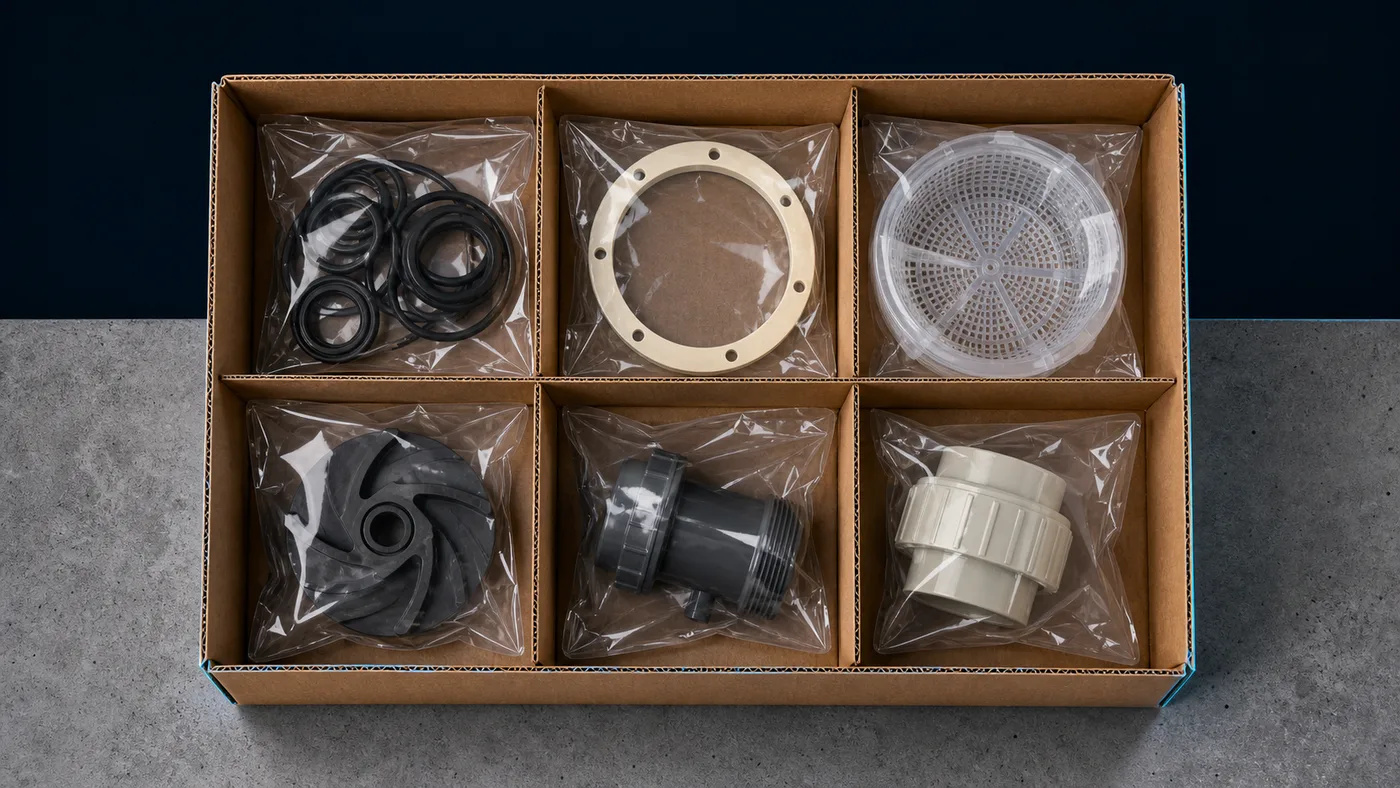
- Can cartons be mixed to reach the minimum?
- What is in a standard carton for this part — piece count and dimensions?
- Do you supply single-piece samples, and what is the lead time?
- If I reorder the same part in six months, is there a setup charge again?
That last one matters more than it looks. Some suppliers treat every run as new; others hold your tool and your specification and treat reorders as continuations. The difference shows up on your second order, not your first.
Sourcing
POOLPOINT sells factory direct with a 50-piece minimum per part, and mixed cartons are welcome to reach the order minimum — you are not forced to take a full carton of each number. Single-piece samples are available so you can confirm fitment before committing to a production run. Send us your list and we will quote it as it stands rather than telling you what to order.