


Distributors tend to pick one model and apply it to everything. That is almost always wrong, because the economics flip depending on the part. A $3 seal and a $600 heat exchanger have nothing in common except that they are both in your catalogue.
The two numbers that decide it
Annual unit velocity and unit value. Everything else is detail.
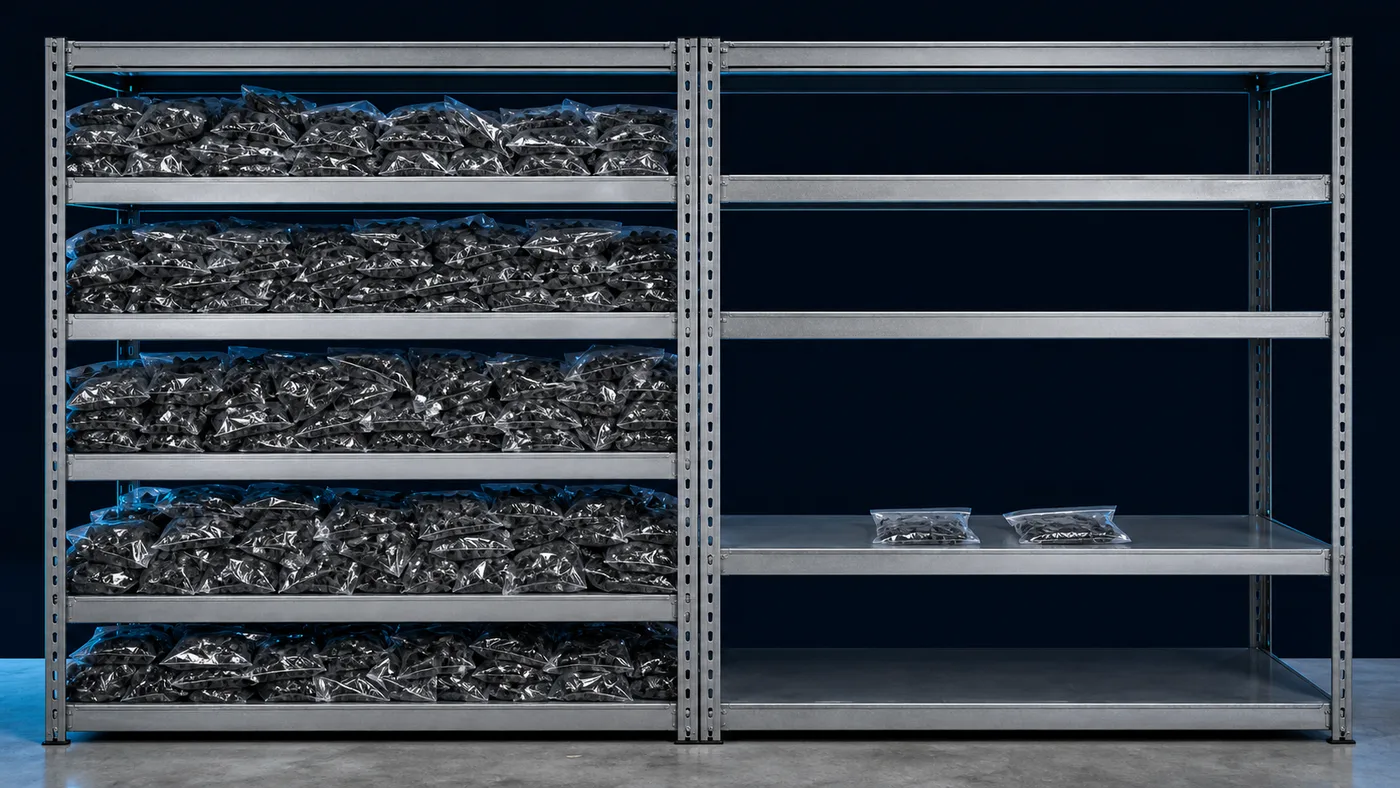
- High velocity, low value → stock it. Carrying cost is negligible, stock-out cost is high
- Low velocity, high value → do not stock it. Capital tied up in something that turns once a year is capital not doing anything
- High velocity, high value → stock it, but forecast it properly. This is where working capital actually goes
- Low velocity, low value → judgement. Cheap enough to carry, but a hundred of these is still a hundred bin locations
Most catalogues have far more items in the bottom-left corner than anyone realises, and that corner is where warehouse space quietly disappears.
The arithmetic
To stock a part for a year costs roughly: capital tied up, plus storage, plus obsolescence risk, plus handling. For a low-value fast mover that total is small in absolute terms.
Against that: the cost of a stock-out. Not the lost margin on that line — the lost basket. A service company that cannot get a $3 seal from you today buys the seal and the four other things on their list from whoever has it.
That asymmetry is why the classic error is under-stocking cheap parts. The downside of holding an extra fifty seals is a few dollars a year. The downside of being out of them is a customer relationship.
The asymmetry inverts at the top end. Holding a $600 item that sells twice a year ties up real capital for months, and the customer who needs one generally accepts a lead time because they know it is not a shelf item.
What drop-ship actually costs you
Drop-shipping — the supplier ships directly to your customer — sounds like pure upside. Three costs are usually underestimated:
Lead time becomes your problem. Your customer's expectation is set by you and delivered by someone else.
You cannot inspect. The part goes from a factory you have not checked to a customer who trusts you. Any quality issue reaches your customer before it reaches you.
Your packaging is not on it. For a private-label programme this is a real conflict — the whole point was your brand on the box.
Drop-ship works best for bulky, low-frequency, high-value items where holding stock is genuinely uneconomic and the customer already expects a wait.
The hybrid that usually wins
Most successful distributors run three tiers:
| Tier | What is in it | Promise to the customer |
|---|---|---|
| Stocked core | 150–250 SKUs covering most unit volume | Same day / next day |
| Managed | Higher value, predictable demand | A few days, reliably |
| Order-in / drop-ship | Long tail, bulky, high value | An honest lead time |
What makes this work is not the tiering — it is saying which tier a part is in, on the listing. A customer who is told "ships in 3–4 weeks" and receives it in three weeks is satisfied. The same customer told nothing and receiving it in three weeks is not.
The listing question people get wrong
Should you list parts you do not stock?
Yes — being findable for a part is how you win the customer, and a distributor whose catalogue only shows shelf stock looks smaller than they are.
But the listing must state the lead time. Vagueness on availability is the single most common cause of complaints in this trade, and it is entirely self-inflicted. "In stock" as a default on a catalogue that is 30% order-in produces a complaint every time one of those is ordered.
When MOQ pushes you toward drop-ship
A 50-piece minimum on a part selling four units a year is twelve years of stock. The instinct is to drop-ship it instead.
Before doing that, check whether mixed cartons change the arithmetic. If you can combine that part with nineteen others in one order to reach a minimum, the constraint largely disappears — you are not committing to a full carton of a slow mover, just adding fifty pieces to an order you were placing anyway.
This is why "can cartons be mixed" matters more than the headline MOQ. It moves parts from the drop-ship column back into the stocked column, where your margin and your delivery promise are both better.
Reviewing the split
Run it annually, after the season, using the same data as your 80/20 analysis. Parts move between tiers — a new equipment line ages into its replacement-parts phase and a slow mover becomes a core item within two seasons.
The specific thing to look for: parts you order in more than six times a year. Every one of those is a stocking candidate you have not promoted, and each order-in carries admin cost and a delivery promise you are choosing to make harder than it needs to be.
Sourcing
POOLPOINT accepts mixed cartons to reach the 50-piece minimum, which is what makes a broad stocked range practical rather than forcing slow movers into drop-ship. Send us your order-in list — the parts you buy repeatedly but do not stock — and we will show you what it looks like as a single consolidated order.